Showing posts with label horns. Show all posts

Tuesday, July 9, 2013

Polled Goat Genetics

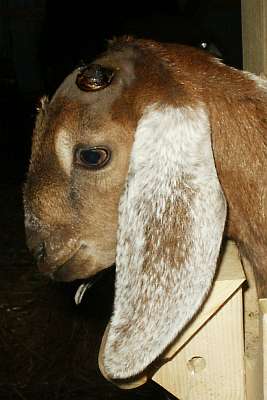
Our new doeling, "Tillie" is naturally polled.
She comes from a horned Registered Saanen Buck and a naturally polled mixed breed Doe (Boer, Nubian, Saanen). Her twin brother was horned and has been disbudded.


Polled Genetics in Goats

Taken From:
Polled Genetics | American Goat Society

Genetics for Polled vs. Horned

The dominant trait is for goats to be polled which is indicated here by the capital P for polled.  Horns are the result of two recessive genes which are indicated here by the lower case p for horned.  You would not be able to tell the difference in a polled animal that carries two dominant genes from one that carries one recessive gene for horned.  This explains how it is possible to breed two polled animals and have some offspring have horns.  This would indicate that both parents carry a recessive gene for horns.

PP: This animal is polled, and does not carry the gene for horns.
Pp: This animal would be polled, and carry a recessive gene for horns.
pp: This animal has horns.  An animal must carry two genes for horns to have horns.

Here are the various breeding scenarios with the resulting offspring:

Horned (pp) X Horned (pp) = 100%  horned (pp) offspring.
Polled (Pp) X Horned (pp) =  50% polled (Pp), 50% horned (pp) offspring.
Polled (Pp) X Polled (Pp) =  25% polled (PP), 50% polled (Pp), 25% horned (pp) offspring
Homozygous polled (PP) X Horned (pp) = All polled (Pp) offspring.
Homozygous polled (PP) X Homozygous Polled (PP) = All homozygous polled (PP) offspring.

Monday, June 17, 2013

We Have New Kids!

Born on Friday, June 14, 2013 at 6:30 and 6:40. The first born is a Doeling and she is naturally polled (no horns) like her Mother. The second born is a Buckling and we aren't sure yet about whether he will have horns or not. I really hope he doesn't because I hate disbudding, but we will have to wait and see.

Here are some pictures that I took of Hazel kidding, so if you are squeamish about this sort of thing turn back now or just close your eyes.


 Hazel needed a little help with the clean up process and Angel needed to make sure everything was alright and that anything that might draw in predators was cleaned up. She also needed some bonding time with her new charges.


The Doeling has erect ears like her Saanen Daddy.


The Buckling has floppy ears like Mom.


Thursday, July 2, 2009

A Little Better

I am somewhat better, I was much better yesterday but went back to somewhat better today. I got outside and did a few things yesterday. I milked all three goats. Cleaned out the buckling's doghouse, gave the bucklings their bottles and then we had to reburn one of Calico's buckling's horns that we didn't do a great job on the first time around.

We also had to reburn both of the horns on the spotted buckling that I am keeping and one of the horns on his twin brother. Those horns were not our fault, they were done by someone else.

I milked Paris for the first time last night. She wasn't fond of the idea but I got through it. Her milk is like Collette's it is naturally homogenized, it had hardly any cream on it at all after sitting untouched in the refrigerator over night. But her milk is also like Collette's in the fact that it isn't as sweet tasting as Calico's.

I have decided to sell Paris and keep Collette, mainly because Paris' teats are just a little too small to hang onto when hand milking. My little milking gadget works great on her but when it comes time to strip her out, it isn't quite as easy.

Tuesday, March 10, 2009

Scurs

For those who do not torture themselves by owning goats; (scurs are caused by a gene and they have nothing to do with bad disbudding! Don't argue with me about this because you will be wrong every time!). They either carry a Scur gene or they don't. Even naturally polled goats can have a scur gene. If you buy a naturally polled goat and he develops a scur don't accuse the previous owner of lying about his horn status. If the goat develops a firmly attached horn that does not wiggle then feel free to accuse.

My own dear Cooter has a really nice scur going on right now. Scurs come and go, they are normally somewhat like a loose tooth, you can jiggle them around a little bit. Cooter doesn't like it but we try to loosen them on occasion, he normally knocks them off himself without too much help from us but the one that he has now is getting quite large. 

They are painful when they are dislodged. They can bleed profusely, leaving him looking pretty mistreated. I always try to put a little blue medicine on the open sore, he doesn't like that either but then the only things that he really does like are Does, food, and a good scratching on his neck and horn area. 

When you mention dehorning or disbudding to goat-minded people, they usually have very strong opinions one way or the other. There are those who would never disbud because they feel that nature intended goats to have horns. They also would never ever put a baby animal through that much pain for 60 seconds. However, these same people do sometimes circumcise their male children. They also feel that horns are there for goats to protect themselves and so on... 

 The other side of this issue, which includes yours truly, believes that horns are dangerous to humans, grandchildren, and even the goats themselves. Goats are experts on sticking their heads in unusual places and mine get their heads stuck even without horns to entangle them. They can also injure their herd mates, human caregivers, and human children by accidentally catching them with a horn. 

 As far as goats protecting themselves with horns go, I believe that a pack of dogs or coyotes don't make the distinction, the horned goats taste just as good. Horned goats also run from danger just the same as unhorned goats do. I strongly believe in disbudding, dehorning an adult goat is another matter. I would not purchase a goat with horns but if the occasion did arise that I came into possession of a horned goat, I would not try to dehorn it. I would however attempt to blunt the sharp ends. 

Even a blunted, loose scur can cause you problems, as demonstrated by Cooter and his human caregiver. I had gone out to feed the rascal and he, being his impatient self was trying to help me pour the feed into the feed pan. I was bent over and he is pretty tall and we somehow got our heads together. His thick, hooked, three-inch scur weaved itself into a portion of the front of my hair that was pulled back in a bun. I also had a hair clasp in the front of my hair and the scur was between my tender scalp and the clasp. I tried to straighten up and was attached to Cooter who was by this time trying to inhale the food in the feed pan. I am not much of one to say that animals are kind, gentle, intelligent, and have human emotions but Cooter did feel the pressure on the scur and instead of jerking away like he normally does when we touch his scurs, he actually moved with me. I just knew that at any moment he would pull away to continue eating but he raised his head and let me untangle us without jerking me bald. It took me several seconds to free myself and I was even to the point of trying to take my hair down but I finally got loose. For once, I was impressed by Cooter's kindness, intelligence, gentleness, and human emotions. But what I really believe is that he was in as much of a predicament as I was in and he knew that if he jerked away it would cause him great pain. So, I still give him points for intelligence.

Thursday, April 24, 2008

Disbudding

Disbudding is the goat keeper's least favorite thing to do. But in fairness to the goats that we raise and to increase their value to both us and the people that may end up with them someday, they need to have their horns removed. It is a nasty job but someone has to do it.

Horns are dangerous for several reasons, but my main reason is that I want my goats to be safe around my grandchildren. Horns can also get easily caught in fences and goats do love to stick their heads into some strange places and at times I don't know how they will get their heads free even without horns.

So, my little Onyx and Jasper were dehorned on Tuesday morning. This process is called disbudding because it is the burning of the horn buds. They should be done as soon as the buds are clearly visible, this is at about two days old for bucklings and a week old for doelings.

The time got away from us because of all the things we had going on. We were way late in getting this done this year. They were two and a half weeks old which is nearly too late to do this successfully for a buckling.

The process consists of taking a very hot tube shaped iron and placing the horn nub right inside the tube and burning a circle around the horn base to destroy the horn root. We use the Rhinehart X-30 Dehorner that we bought online at Jeffers Livestock Supply.

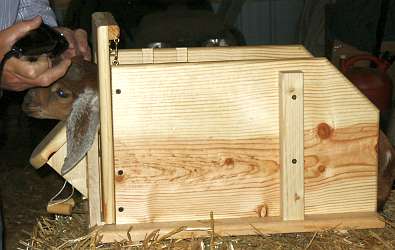
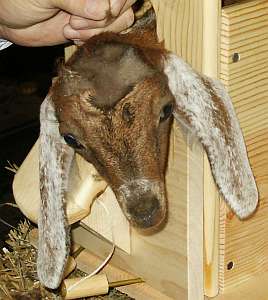
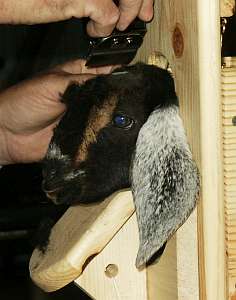
We first place the kid in a box especially designed for this propose to shave all of the hair away from the horn area. Then when the iron is glowing red, I hold the kid's head still, while my husband applies the hot iron to the bud. He applies pressure in a circular pattern, clockwise, around the horn base while I count off 10 seconds.

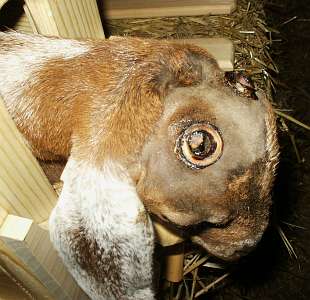
When the iron is removed, I blow on the area to quickly cool it off. We then inspect the area to see if we have a perfect copper colored ring around the entire bud and to give the iron a chance to reheat before going to the next horn. If it isn't an even ring, we will come back later to even the ring out. When both sides are done we then burn or nudge the top of each horn bud with the hot iron.

This is a very stressful thing for the kids to go through, but they always return to play as soon as the are released from the box. So I am not sure that it is extremely painful for them. Goats have pretty hard and thick skulls. Usually they cry just as much about the shaving experience as they do for the burning but this year the babies didn't seem to mind being shaved. I think that the whole thing is harder on us than it is on them.

Shaving the Kid's head
Jasper in the Box

Jasper
Horn area being Shaved

Onyx
Shaving Onyx

Disbudding
Copper Rings

Dehorning
All Done!

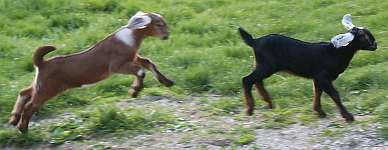
Goat Kids at play
Back to Playtime.


ShareThis